
As a health-conscious vegan who eats a mostly whole food plant based diet, cholesterol wasn’t on my radar until my 48th birthday in December 2025. When I talked to my mom that day, the first thing she said to me was: “Your grandmother was 48 when she died.” Thanks, Mom! Remind me what she died of? Mom told me it was “angina.” Today, we’d probably say “heart attack.”
The conversation triggered me to revisit my most recent blood work results, from May 2025. My doctor hadn’t raised an eyebrow at the time, but I was shocked to discover that my LDL had crept up from 80 mg/dL in 2021 to 102 mg/dL! This was not a good trend. Just like my weight had subtly but surely increased a few years earlier, my LDL cholesterol was possibly going to become an issue if I didn’t do anything about it.
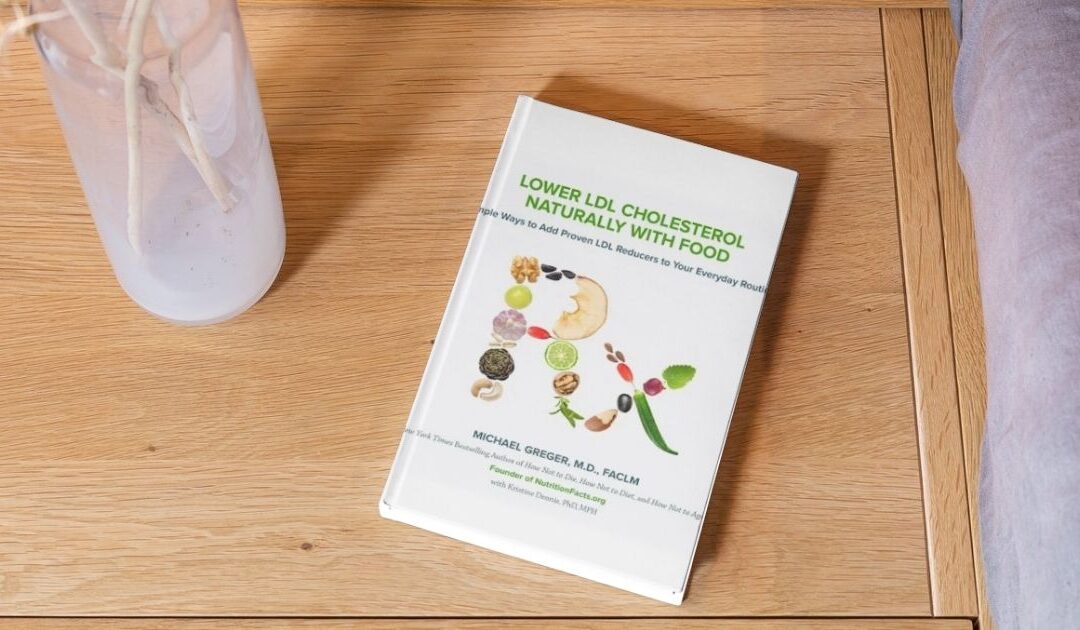
Thankfully, guidance was at hand: just a few months earlier, Dr. Michael Greger (of How Not to Die fame) had published a tiny book called Lower LDL Cholesterol Naturally with Food: Simple Ways to Add proven LDL Reducers to Your Everyday Routine. I quickly read it – it’s just 50 pages! – and decided to make it a summer experiment along with members of the Plantwise Book Club.
In this post, I share the key points of Dr. Greger’s book and report back on my own experimental results. For the sake of science, I got my finger pricked four times between April and September 2026 to find out my blood lipid level. In-between each test, I tweaked my nutrition. In the conclusion, I will share some thoughts about risk and rewards when it comes to improving biometrics such as LDL cholesterol.
⚠️ DISCLAIMER: I am a Certified Lifestyle Medicine and habit coach, with a PhD in sociology, NOT a licenced medical doctor. This article is a book review of Dr. Greger’s book on LDL cholesterol and an overview of my own medical history as I experimented with his suggested diet tweaks. I am providing it for education purposes only. If you have any reason to be concerned about your heart health, please consult with your primary care professional, preferably a plant-friendly medical doctor.
The book in context
Dr. Michael Greger is the ultimate nutrition nerd. Though he started a MD-PhD program, he decided to focus on the medical degree because he figured that it was more urgent to communicate what we do know about disease prevention rather than create new knowledge about it. His medical career has been focused on communication rather than clinical practice. His goal: put the science in front of the people who need it, so they can make their own informed health decisions. This is in contrast to the medical mainstream. Most physicians believe that their patients probably won’t change their lifestyle. They are quick to prescribe pharmacological treatment for heart disease instead of dedicating effort to educating their patients (or themselves!) about possibly life-saving nutrition habits. Dr. Greger takes it upon himself to share what’s in the peer-reviewed studies with the greater public… even if it risks overwhelming his audience with nutritional minutia. Clearly, there is an appetite for this: his books have been New York Times bestsellers and translated in at least 30 languages, while his YouTube channel has almost 1.5 million subscribers.
But Lower LDL Naturally with Food isn’t like How Not to Die. The tiny volume (84 pages including references and the index) was self-published by NutritionFacts.org, and is only available via Dr. Greger’s website and Amazon. It feels like Dr. Greger decided to organize his own notes on the topic of LDL cholesterol reduction in a format that he could easily share quickly, not unlike his other tiny books about GLP-1 drugs and Ultra-processed Foods.
The premise is that LDL cholesterol must be reduced, as it’s the top driver of heart disease and very responsive to diet. The book isn’t about the why; it’s about the how.
What Dr. Greger says we should do to lower LDL cholesterol
The book is divided into three sections:
- a comprehensive chapter on statins (the drugs used to lower LDL cholesterol),
- then a detailed overview of the “Portfolio diet” and related nutritional interventions to lower LDL,
- and finally Dr. Greger’s description of his own slightly quirky way to consume more LDL-reducing food and substances.
Spoiler: despite the book’s subtitle, I wouldn’t call it “simple.”
Greger is starting from this view:
“LDL cholesterol, also known as “bad” cholesterol, is “unequivocally recognized as the principal driving force” in the development of atherosclerotic cardiovascular disease, our leading cause of death.”
He takes to heart the idea that we should aim not for the old 100 mg/dL target (for low-risk people), but for “as low as possible,” which is how he interprets the new management guidelines for blood lipids (cholesterol).
“So, even with an LDL less than 100 mg/dL that your doctor may consider “normal,” it is considered of “utmost importance” to lower it further, even if other heart disease risk factors are considered optimal.”
In the conclusion, I will revisit this premise, but for now let’s play along.
Who needs statins?
Are you looking for an anti-pharma rant? This is the wrong book for you. Dr. Greger says it plainly at the end of the book:
“… if my ten-year risk of cardiovascular disease creeps up to 5%, I’ll add a statin in a heartbeat.”
What he is talking about here is the risk of a major heart event, such as a heart attack or stroke, heart failure, angina, or intermittent claudication (difficulty walking caused by cardiovascular system blockages).
But how to calculate your risk? You need your just three numbers: your blood pressure, total cholesterol, and HDL.
In the first chapter, Greger suggests using the European u-prevent.com risk calculator. Personally, I found the Canadian decisionaid.ca/cvd tool far easier to use for non-medical professionals. (You can click the measurement unit to switch from American to international units. This article is written using American units.)
Below, you can see my risk on the Canadian calculator based on my 2025 test. My baseline risk then was about 3 percent, but with the “treatment” applied (Mediterranean diet and physical activity) my risk goes down to 1.5 percent.
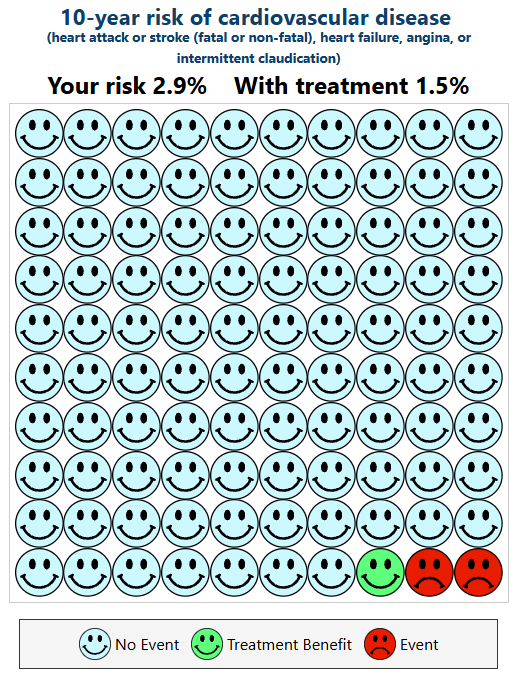
My cardiovascular disease risk calculator based on my May 2025 lab results.
Based on the European guidelines, this would put me in the green zone where “lifestyle advice” should be offered by my doctor.* However, the new guidelines put a lot more people than before in the “yellow” zone where they should be advised to change their lifestyle and consider statins.
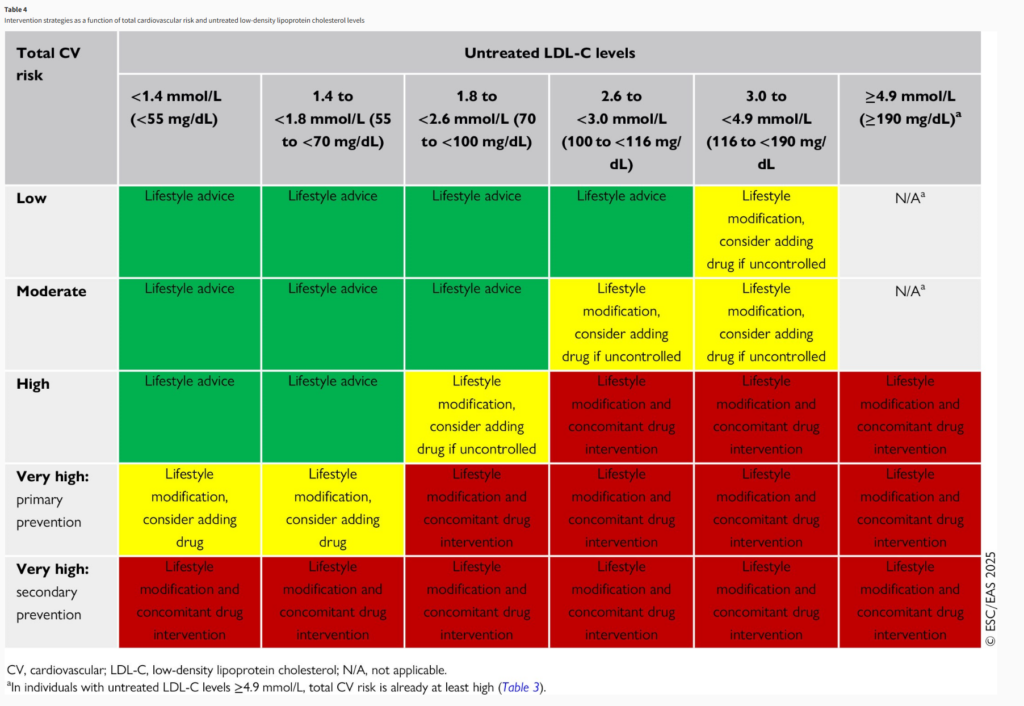
European guidelines for intervention strategies based on cardiovascular risk and LDL levels.
Dr. Greger sees statins as potentially life-saving, and fully embraces the risk reduction strategy of the new, more proactive guidelines. However, he also wants people to be clear-eyed about the risks and benefits of taking the drugs and make their own decision rather than blindly trust their doctor. Hence, the rest of the chapter is dedicated to reviewing how statins work and what side-effects are commonly associated with them. Those include an increased risk of diabetes, muscle disease, and fatigue. Note that, despite the risks, statins are “non-negotiable” for those who have already suffered a heart attack.
Statins are an option, but, based on the guidelines, most people should be working on lifestyle modification to bring their LDL down. Diet is a top tool, and the rest of the book explains what to do in detail. It starts with the Portfolio Diet.
What to eat and not to eat
The Portfolio Diet, first developed by David Jenkins about 20 years ago, describes both what we should avoid and what we should include to bring our LDL cholesterol down.
What to avoid? The fats that raise LDL cholesterol: trans fat, saturated fat, and dietary cholesterol. Trans fats are now banned from food manufacturing, but very small amounts occur naturally in meat and dairy. Dietary cholesterol is also only present in animal products. As for saturated fat, it is primarily found in dairy, meat, and desserts, including many vegan ones.
What to include? There are four main categories:
- Nuts (a small handful daily)
- Plant protein (basically lots of beans)
- Viscous fiber foods (grains like barley and oats, veggies like okra and eggplant, and flax)
- Plant sterols (primarily in supplement form)
The first three categories are not mysterious, and easy to integrate into most plant-forward diets. Plant sterols, however, were new to me. I appreciated the book’s detailed explanation about how they work to “flush” cholesterol from our bodies, and a nuanced perspective on whether we can actually count on them to reduce our risk of heart attacks. Greger is convinced enough that the answer is “yes” to recommend taking a plant sterol supplement, because it’s practically impossible to get a meaningful dose from whole foods, even when sticking to the Daily Dozen religiously.
From there, the book veers toward more nutritional tweaks, some of them reasonably common (psyllium husk, sumac, garlic powder…) but others firmly in the “weird ingredient” category (artichoke extract, anybody?). Dr. Greger also warns against supplements to avoid due to the “sketchy” evidence supporting them.

Dr. Greger eating his “nasty” (but proven) supplements wrapped in edible film.
But what does the author himself do? In the book’s third chapter, “Putting it all into practice,” Dr. Greger explains how he creates big batches of his “Portfolio Plus Powder.” You can watch him do it in this video. Warning: it may feel over-the-top. Greger himself acknowledges it:
I can imagine how this could all seem a bit overwhelming, but you can benefit even if you take a few simple steps. Even if you just did one thing, like adding some apples to your diet.
From there, Dr. Greger recommends experimenting with the different ways to lower our cholesterol. He also makes suggestions for how to track our progress and see what actually works for us. I decided to take him up on it and put (some of) his suggestions to the test.
Whatever you do, however you test, let every heartbeat be a reminder to take better care of yourself.
Why would I want to do this?!
Even with my LDL at 102, my risk of a critical heart event in the next 10 years was under 2 percent, as you can see from my decisionaid.ca chart above. The odds are low that I will get angina and die the way my grandmother did at my age. But clearly my numbers were headed in the wrong direction. Every year of age increases risk. I don’t want to find myself at 60 years old with a 10 percent risk or worse.
At first brush, Dr. Greger’s elaborate batching and packaging of supplements with edible film was a “no” for me. Nevertheless, I was curious to experiment with the LDL-reducing foods that I could use in a culinary way. In other words, if I could tweak my everyday meals to boost my body’s ability to “flush” LDL, then why not! Perhaps I would even discover new ingredients that taste good along the way.
Between April and September 2026, I had my LDL tested four times. Here are my results.
My Spring and Summer 2026 experiment
- Prior data point: May 28th, 2025:
- LDL at 102 mg/dL
- Eating a generally WFPB diet but not intentionally targeting LDL reduction.
- Winter and spring 2026 nutrition tweaks, after that scary conversation with my mother:
- Became very regular with eating overnight oats every day. My breakfast also includes chia seeds, walnuts, and frozen blueberries.
- Added amla powder (not as bad as they say, in fact I kind of like it!), bumped up flax seed from 1 tsp to 1 Tbsp, and introduced sumac, all included in my overnight oats most days.
- Weekly-ish consumption of okra (thanks to a cooking club member who explained how she cooks it!) and eggplant in stir-fries.
- First test: April 29th, 2026:
- LDL at 86 mg/dL – down 16 points since my test 11 months earlier.
- Note: I also learned that my Lipoprotein (a) is 94 nmol/L or 44 mg/dL, which puts me in the medium risk zone (a bit elevated but not “high”). This topic is not discussed in this book; I’ll write a separate post about this some other time.
- I made this YouTube video about the results so far.
- Late-spring 2026 nutrition tweaks:
- Added barberries to my morning oats.
- Started making my soy milk from black soybeans, having about 3/4 cup every day in my oats.
- Not specifically mentioned in the LDL book, but I also ate my big lunch salad practically every day in this period, including about two cups of dark leafy greens, whole grains, and tofu or beans, plus a bunch of other wholesome ingredients.
- Kick-off of the Plantwise Book Club group study of the Lower LDL Cholesterol Naturally with Food book on June 25th, 2026
- Second test: July 20th, 2026:
- LDL at 73 mg/dL – down 13 points from 3 months earlier!
- That got my pharmacist’s attention!
- I was pleasantly surprised by the results. I had been very regular with the LDL-reducing habits except for one week of travel in early July. Since it was close to the testing date, I thought it would bring the numbers up, but it looks like it didn’t.
- Summer 2026 nutrition tweaks:
- Summer chaos kicked in and my eating routines went sideways a bit.
- Maintained the overnight oats with all the extras (amla, sumac, barberries…) but often didn’t have black soy milk, so used regular one instead – it counts for the Portfolio diet at least.
- Psyllium husk was introduced. I added a teaspoon to my overnight oats most days, and occasionally had another spoonful of it in a glass of water. Viscous indeed! I really didn’t like it but stuck with it for the sake of the time-limited experiment.
- Hardly any other viscous-fiber foods, didn’t get around to buying okra or eggplant as much. Lunch salads were less regular.
- More eating out, sweets, and treats, including vegan ice cream and fried delights that contained more saturated fat than I normally consume.
- Third test: August 19th, 2026:
- LDL back to 86 mg/dL – up 13 points from July
- Lost the mid-July edge. Unsurprising considering that many of the positive tweaks I had made in early summer were set aside.
- Late summer 2026 nutrition tweaks:
- Started taking a plant sterol supplement, 4 mg/day (half with breakfast, half with dinner).
- Continued with the overnight oats with all the fixings, though I ran out of psyllium husk in early September.
- Fewer sources of saturated fats and return of lunch salads as the kids went back to school and my schedule got closer to regular. Still, diet quality still less than at my late-Spring/early-Summer best.
- Fourth test: September 16th, 2026:
- LDL at 78 mg/dL – down 8 points from August and from my April baseline.
- This isn’t a controlled experiment where I tweak only one factor at a time, so it’s hard to tell for sure, but I think that the addition of plant sterols nudged my LDL down despite the still-somewhat-chaotic diet.
That’s it. I’m giving my fingers a break from the monthly pricks for a while!
4 lessons learned from my LDL-reduction experiment
There’s four big lessons I learned from my experiment following Dr. Greger’s suggestions from Lower LDL Cholesterol Naturally with Food.
#1 Big efforts, big results. Small efforts, small results.
As a health coach, I always emphasize the value of small habit tweaks because that’s what gets the habit wheel turning. I also know that, to get to a health transformation, one needs to continue growing the habits until they can make a significant difference.
My LDL experiment supported this. I had the most significant LDL-reduction results from the two big change phases:
- Phase 1 in early 2026 included adding viscous-fiber veggies (okra and eggplant) on the regular, plus sumac, amla powder, and a boost in flax. This came on top of the good stuff I was already doing (oats, blueberries, mostly WFPB…).
- Phase 2 in late-Spring and early-Summer had all of the previous improvements plus black soy milk, barberries, and practically all home-cooked meals, including a daily hefty dose of dark leafy greens and other WFPB goodies.
Ornish says it, Greger says it, and it’s true: small efforts lead to small results, and big efforts to big results. I wouldn’t say that my “effort” was big, because I was starting from a very healthy way of eating to begin with. However, I was very intentional about my food choices throughout phases 1 and 2, cooking almost all of my meals, and ate few fatty or sweetened foods. It showed in my lowered LDL.
#2 Routine is good for me.
The overnight oats breakfast habit is the pillar of my health. (You can see my YouTube video about it from December 2025.) It includes several foods of the Portfolio Diet (oats, beans as soy milk, nuts) plus a bunch of the tweaks that lower LDL (amla powder, sumac, barberries). I’ve now found a supply of black soybeans and already had a routine of making my own soy milk. As long as I’m eating eating breakfast at home, I’m covered. When traveling, I bring my breakfast mix along and just add regular soy milk the night before.
And I don’t get bored of it! In fact, I get up in the morning, having fasted since about 7 p.m. the night before, looking forward to eating breakfast at 8 a.m. I would hate having to decide “what’s for breakfast?” every day. I switch up the fruit a bit sometimes, and sprinkle different nuts and seeds on top when I feel like it, providing variety.
Similarly, whenever I stick to my Big Bowl Lunch routine, I feel great. Like: really, really good. It’s not as closely tied to LDL-reducing foods, but eating greens, whole grains, and beans or tofu aligns with the best advice to promote heart and brain health. Eating at home and having the right ingredients available, including whole grains and a dressing batched the weekend prior, makes it possible. Compared to my overnight oats breakfast, Big Bowl Lunch is a little less under my own control. Whether it happens is more influenced by factors like appointments, my kids’ schedule, and travel. When I pull it together, though, it’s glorious, allowing me to hit all of the Daily Dozen points before 1 p.m.
#3 Eating out, sweets, and treats don’t serve my heart.
The best croissant I’ve eaten in my life was a vegan croissant… which doesn’t make it healthy. Vegan treats are as good or better than those made with animal products… and they are just as capable of raising LDL cholesterol due to the saturated fat they contain. That’s probably what happened between my second and third test, as my LDL crept back up while I was traveling and indulging in decadent desserts.
I don’t want to completely banish sweets and treats from my life because there is genuine joy and playfulness in a cone of (vegan) ice cream with sprinkles. But from a health perspective I do better when I enjoy such things once per week or less. My long-term ability to stay active and independent is more important to me than the ephemeral pleasure of a second, third, or fourth treat in the same week.
As for eating out, I already minimize it when at home. This experiment highlighted how, when traveling, it’s worth it for me and my family to rent accommodation with a kitchen and mostly cook simple meals instead of seeking restaurants that cater to our preferences. My kids actually would rather eat at “home” quietly, and I dig “grocery store tourism” at least as much as I enjoy supporting vegan restaurants in a new town.
#4 If it’s not in my meals, I’m not having it.
Supplements are not my thing. I take vitamins B12 and D because I have to. Other than that, I strongly prefer getting my essential nutrients in a way that enhances my regular meals rather than in pill form. With whole food plant-based eating, that’s generally easy, and that’s what I want to stick to.
This LDL-reducing experiment had me adding psyllium husk to my overnight oats. It added soluble fiber but no enjoyment. I found it gross and couldn’t get myself to take enough to be clinically significant.
In the third phase, I took 4 capsules of plant sterols daily. Because this wasn’t a controlled experiment, and multiple variables were changing at the same time, I can’t be absolutely certain of this, but I am guessing that the plant sterols helped keep my LDL under 80 despite the less-optimal diet in late-Summer.
In the future, if I was going to be traveling for a long time in places where fresh produce might be hard to find while saturated fat was abundant, I would probably consider packing plant sterol supplements. But for my current everyday life I will focus on intentionally boosting the nutrient content of my meals instead of adding a supplement. My July test results are testament to the fact that keeping my LDL low isn’t that hard as long as I’m intentional about including delicious LDL-reducing ingredients at every meal.
How low do I want to go?
Dr. Greger says that we should set the bar “as low as possible” when it comes to LDL cholesterol. I suppose that, if I did everything “perfectly” and also took the plant sterol supplement continuously, I might get mine below 70 mg/dL. This might take my 10-year of cardiac event from 1.5 percent to under 1 percent. So what?
The level of orthorexia – the unhealthy obsession with eating perfect food – required to get there would increase my stress and strain my relationships, which would undermine my health more than the occasional piece of cake.
My strategy is bound to change if my LDL, despite my intentional diet improvements, increases again. I’ll test annually to see.
I’m not saying that I will never take a supplement or a statin. If my risk increases to over 5 percent I will probably start by experimenting with a stricter diet. In light of my family history, I will also consider plant sterols and, if they don’t do enough, statins. But maybe I’ll decide to take my chances. We’ll see!
How low do YOU want to go?
What if your LDL is high, like over 116 mg/dL? What if you are already in the red zone or have already had a heart attack or stroke?
Obviously, you need to discuss this with your physician. I also recommend reading Dr. Greger’s book Lower LDL Cholesterol Naturally with Food yourself. Calculate your risk ratio and make your own decision about whether to change your diet, increase exercise, take supplements, and/or take statins based on the best available evidence and advice you can get.
Whatever you do, you have to know this: changing your habits IS POSSIBLE. You might need a bit of extra support. But it can be done if you put your heart to it.
There is no doubt in my mind that the guideline change was welcome by the pharmaceutical companies that benefit from statin sales. However, drugs are not the only or even the best option to decrease our LDL cholesterol. Dr. Greger’s book makes the point repeatedly through the book. Experimenting with his advice over six months demonstrated to me that diet improvements can decrease LDL… and diet degradation increases LDL.
Another possibility is to accept one’s risk. Let’s say the calculator says you have a 10, 20, or even 50 percent chance of having a significant heart event in the next 10 years, how do you feel about that? You have to be aware that it may not be an immediately lethal heart attack. It could be a debilitating stroke. We don’t know. Your doctor is probably uncomfortable with that level of risk, and will insist on medication. Whether you take it or not is up to your own assessment: what risk is acceptable to you?
There is no shame in taking a statin. It’s not a marker of weakness! The world around us is NOT structured to support healthy lifestyle choices. Life is stressful and we have a lot to do, sometimes too much to take care of our health. Even when we decide to change our habits, improvements may come slowly. The statin may buy time while looking for the right flow in the kitchen. For me, it’s been a wholesome breakfast. For you, it might be something else. Keep on experimenting.
For the vast majority of people, eating more whole plant foods and moving more are almost always possible and good ideas. Whether or not you need a statin, you can almost certainly improve your diet – now. Need help to get going? Book a call with me, I’ll help you find the motivation and a system that works.
Note *: Technically, now that I know that my Lp(a) number is medium-high, I actually would have fallen in the “moderate” risk and thus in the “yellow” zone back in May 2025 due to my LDL being at 102 mg/dL. My doctor, had she known about my Lp(a) then, should have suggested “lifestyle modification” and “consider adding drug if uncontrolled.” However, by April 2026, with my LDL having dipped at 86 mg/dL, I did not receive a follow-up call, presumably because it keeps me in the green zone.
Brigitte Gemme is a Certified Lifestyle Medicine and habit coach. If you’re interested in embracing healthier habits, consider booking a conversation with Brigitte to find out if habit coaching would be useful for you.