
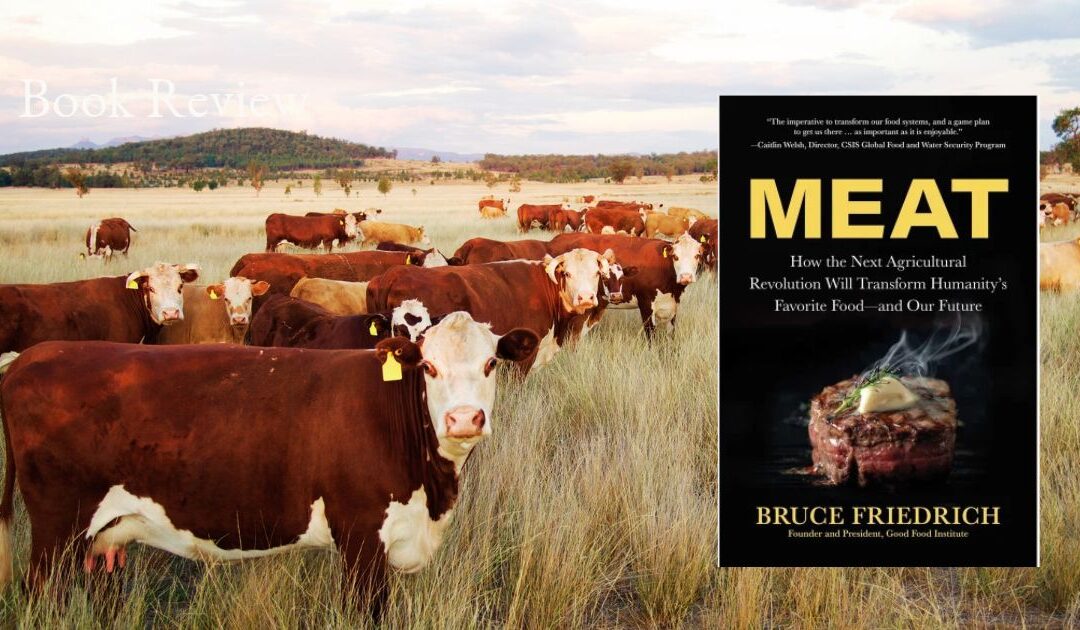
Alternative meat disturbs me. I’m talking about the plant-based meats that feel so close to animal flesh, such as Impossible’s ground “beef,” as well as the cultivated meats grown from cells extracted from real live animals. My concern doesn’t arise from disgust at the texture or a quest for vegan purity. Rather, since reading Bruce Friedrich’s book Meat: How the Next Agricultural Revolution Will Transform Humanity’s Favorite Food – and Our Future and interviewing him for the Plantwise Podcast, I have been obsessed with this ethical dilemma: is the development of alt-meat really the best use of our brightest minds and public funds, or should we instead massively invest in other approaches to solving the problems caused by humanity’s insatiable appetite for meat?
Bruce Friedrich’s book Meat is a fantastic overview of the subject, written by a fierce advocate of alt-meat technologies. The author, who happens to be a vegan of 40 years, and a very smart cookie, holds the deep conviction that alt-meat is “our best shot” at solving the thorniest, most urgent problems of our civilization: world hunger, climate change, environmental destruction, antimicrobial resistance, and pandemics. As the founder and president of the Good Food Institute, a global think tank committed to the development and widespread adoption of alt-meat products, Friedrich is passionate, articulate, and convincing. He has thought this through, and he’s throwing every bit of talent he has – and whatever he can recruit! – to the task.
Listening to him, the anxious part of me that worries about the future wants to be convinced that he’s right and that alt-meat will inevitably save the world if we give it the chance it needs. But the calmer voice, deeper inside, asks: might alt-meat technology, though amazing, be another techno-fix that distracts us into thinking that we are solving the problem while we are, in fact, only escaping into the future? Worse, could alt-meat be yet another example of a technology that worsens the overall situation and increases global suffering?
If you are an ethically driven vegan, environmental activist, or public health advocate, I invite you to read this essay to do two things with me: first, review the key points from Friedrich’s book about alt-meat; second, reflect on the broader context of how we humans use technological innovation to fix our behavioral problems. My ambition isn’t to offer a definitive answer to the question of how we should use our precious time on earth, but to share how I come to my own decisions on this matter right now.
Spoiler: much of the answer hinges on answering two other questions. First, can people change their habits? Second, who benefits when they don’t?
The case for alt-meats
Some technologies, like smart refrigerators, bring solutions to problems we didn’t know we had. Alt-meat technology, however, matters not just because it’s novel and cool, or even because a lot of humans think it’s wrong to use animals for food. Rather, Friedrich argues that alt-meat needs to be developed because it tackles the many catastrophic problems linked to con-meat production at their root.
But first, what are we talking about?
Alt-meat types
What is Friedrich talking about when promoting alt-meats? There are two main types:
- Plant-based meats are products already common on the market, such as Beyond Burgers, Impossible Meat, and Gardein meat substitutes. Those products are made of plants processed through advanced manufacturing methods to (attempt to) mimic the taste, appearance, and mouth-feel of animal meat. This goes beyond the bean burger of 1980s and involves advanced ingredient transformation technologies.
- Cultivated meats are actual animal tissue (muscle and fat) grown in fermentation vessels from a few cells originally taken from a real animal. The manufacturing plants look like beer breweries. Those are sometimes referred to as “lab-grown” meats.
According to Friedrich, despite some efforts so far, we do not yet have alt-meat products that are good enough for meat eaters to adopt them systematically as a substitute for conventional meat – let’s call it “con-meat.” (This is not a term Friedrich uses, but I’ll use it for… convenience.) Existing plant-based products mostly don’t quite taste or feel right yet, and the cultivated products that are closest to the con-meat experience are still far too expensive to compete.
Friedrich’s vision, which is also that of the Good Food Institute, is to get alt-meat to “taste and price parity.” Alt-meat should taste as good (or better) and cost the same (or less) than con-meat, so that a large proportion of the population will switch their buying pattern. In the author’s vision, this is an innovation problem. Based on his experience, and querying many experts on the topic, Friedrich believes taste and price parity are within reach… as long as scientists, engineers, governments, and business work hard enough together.
Conventional meat’s big problems
But, wait, let’s backtrack here: why do we even need alt-meat? Friedrich points to four problems driven by con-meat: world hunger, climate change and environmental destruction, antimicrobial resistance, and pandemic risk. In his view, each problem is mitigated or even eliminated by alt-meat.
First, world hunger.
Though Friedrich himself is a vegan (even if he doesn’t exactly advertise it), he does not foreground animal suffering: he says that what made him turn to plant-based eating four decades ago was the discovery of just how inefficient animal agriculture is. That’s still what he talks about first when describing the many problems caused by humanity’s taste for flesh.
The food waste supremely bothers him, as it does most of us. We gasp when watching him throw away eight perfectly good plates of pasta to keep just one to eat, as he does in his TEDx Sonoma County talk in 2017.

The stunt on stage makes us flinch, but how many of us actually worry about the far larger picture of food waste at the system level? Friedrich argues that, to produce 100 calories of chicken, it requires about 900 calories of animal feed, because some of the calories are “spent keeping the animal alive or producing nonedible parts of the bird.” That “wasted” food (the animal feed) is apparently responsible for 30 times as many lost calories as direct food loss and waste at home and at the store.
Meanwhile, there’s more than two billion people living with significant food insecurity, not because food is scarce but because it’s too expensive and thus poorly distributed. Alt-meat, which is at least three times as efficient, drastically reduces this waste, thus plausibly reducing food costs.
Growing all that wasted food destroys the planet.
Meat production has a bigger climate impact than the entire transportation sector, notably due to the methane emissions of ruminant animals and the deforestation required to make space for animal feed crops and grazing land. So Friedrich argues that, if we could reduce the demand for animal-based meat, we could liberate hundreds of millions of hectares of agricultural land, making it (theoretically) available for reforesting and rewilding. In so doing, we’d capture the carbon emissions of other sectors of the economy. It would also make space available for regenerative farming practices.
Friedrich cites calculation from other organizations reporting that with “a 50% global adoption of alternative proteins, would could avoid five billion metric tons of carbon emissions annually.” Those are the kinds of savings we need to meet our global targets in emission reductions, or at least slow down the degradation of the climate. Without alt-meat, Friedrich posits, our carbon emission reduction goals will forever remain out of reach.
Animal agriculture threatens to neutralize medicine.
For decades, global medical bodies have warned us that we are losing our ability to fight infections because “superbugs” have evolved the power to shrug off our main antibiotics and other antimicrobial drugs. In 2022, The Lancet published a report indicating that antimicrobial resistant infections killed 1.27 million people in 2019 and contributed to another 3.5 million deaths. That’s worse than AIDS or malaria.
Many of us have felt guilty taking antibiotics to treat an infection, but the reality is that more than 70 percent of antibiotics produced by the pharmaceutical industry are fed to animals to speed up their growth and prevent disease in overcrowded and stressful industrial farming. Now that fish farms also use antibiotics, the situation is bound to deteriorate further.
Plant-based meats require no antibiotics; producers of cultivated meats have committed to not using the drugs.
Pandemics start in animals.
We may already have forgotten the scale of the disruption and despair brought on by the global COVID-19 pandemic, but the next one can’t be far into the future. Global health experts have repeatedly pointed out the dangers, and highlighted that death tolls could be far greater than what we’ve recently experienced. Friedrich adds that, as discussed in Michael Greger’s book Bird Flu (republished more recently as How to Survive a Pandemic), industrial farms are the perfect breeding ground for pathogens that will multiply and eventually mutate into a variant that can be transmitted to humans, and then from human to human. Eating animals has been connected to most past pandemics, and it’s going to happen again until we learn our lesson and do better.
Alt-meats can provide nourishment for humanity without contributing to pandemic risk.
But humans can’t stop, won’t stop eating meat.
The problems above, described in detail in Meat’s first four chapters, aren’t new to anyone in the vegan and plant-based world. There has been substantial activism to decrease the amount of animal products consumed since at least the publication of Diet for a Small Planet by Frances Moore Lappé in 1971, yet only a tiny fraction of today’s population is vegan or vegetarian. Globally, meat consumption still grows year after year, and more animals than ever are killed.
As economies develop and populations are lifted out of poverty, the demand for meat increases. Even in so-called rich countries, animal protein still occupies the top spot on menus and meal plans everywhere. Among other statistics, Friedrich reports that 80 percent of middle-aged Americans eat fast food at least once per week, and many eat it more often, especially young people. Those meals are mostly meat-centric.
Most people say that they are cutting back on meat… but it’s not actually reflected in the real data about meat production and consumption. Friedrich points out that “public education and advocacy efforts have been wildly successful at getting attention and have improved the diets of many millions of people…” but, sadly, significant world-shifting change has not happened. Whatever we do to promote plant-based diets just isn’t enough.
“Just like the world is going to consume more energy and drive more miles, the world is going to eat more meat. Meat is just too visceral a desire, too culturally embedded, too normatively accepted. We’re very unlikely to change any of this. But we can change the way meat is made.”
In sum, Friedrich says that meat is humanity’s favorite food, and he does not believe that can change, so we need to focus our energy on making meat better. In other words,
“If we’re going to address the world’s insatiable craving for animal meat, we’re going to have to replace like for like.”
I’m far from convinced that we have tried as hard, or as successfully, as Friedrich says, and I will return to this point, but first here’s a quick overview of the rest of the book.
An alt-meat boom is possible sooner than we think… if we all put our shoulders to the wheel
After presenting the problem with con-meat in the first part of the book, and staking his claim that plant-based diets won’t satisfy enough people to mitigate those problems, Friedrich dedicates the third and final part of the book to making the case for alt-meats’ economic and political benefits. He argues that:
- taste-and-price comparable alt-meats are within reach thanks to the power of science and technology;
- alt-meat innovation would be economically beneficial and even existing meat companies are backing it;
- and alt-meats can play a critical role to maintain food security, a concern that’s top of mind especially in countries such as China, Singapore, and Israel.
The Good Food Institute, which Friedrich leads, makes it its mission to bring together the scientists and engineers, business leaders, and policy makers to get there faster.
To the naysayers who don’t believe that alt-meat can ever approach the appeal of the conventional stuff, Friedrich says that they are just as short-sighted as people who believed no-one would ever want a car or personal computer… just years before those innovations became mainstream. In the case of cars, for example, only about 8,000 cars had ever been sold in 1900, but less than 10 years later over 200,000 cars were sold. “Within five years, cars were more popular than horse-drawn carriages.” So why wouldn’t alt-meat overtake con-meat if the taste is good and the price is right?
Friedrich is confident that, with everyone pushing together in a coordinated manner, an adoption boom is possible for alt-meat. To this end, he concludes with a call to action inviting readers to dedicate their careers to alt-meat innovation, or at least to encourage others to support this critical innovation.
“The power of one person to drive meaningful change is incalculable.”
We can take jobs in the area, invest in the companies that develop alt-meat technologies, nudge public policy in the right direction, and generally “work to incorporate alternative proteins into the work of [our] organization[s].”
And, of course, we can donate to the Good Food Institute, which is a top-rated charity in terms of positive impact for the environment.
Friedrich is optimistic: having been committed to alleviating suffering since he was 13 years old, he finds it “deeply motivating to know that, after decades of watching industrial meat consumption’s inexorable rise, we have a solution that could reverse that trajectory.”
Bruce, I want to believe you… but I’m far from convinced that alt-meat is the solution. Here’s why.
Alt-meat as a techno-fix
Humanity’s insatiable appetite for meat has brought the planet and much of its population to the brink of disaster (or beyond…) – Friedrich and I agree on that point. However, unlike him, I can’t be optimistic about the potential of alt-meat to actually address suffering and inefficiency. I’m even concerned it will make at least some of the problems he discusses worse.
My concern comes from the foundation of his argument: Friedrich believes that humans can’t change their taste for con-meat, so we have to support industry to develop alt-meat technology to supersede it.
To the contrary, I believe that humans can change their habits, and I have seen it happen many times around me, including through my coaching practice. However, such change requires, first, a deep consideration for the well-being and personal growth of individuals. Second, change requires nurturing a wholesome environment that makes “good” habits easy to adopt. Unfortunately, this orientation is contrary to the interests of corporate forces, whose profitability hinges on environmental destruction and individual sickness, as opposed to preservation and health.
In the past, when the unfortunate consequences of human behavior have been addressed with technology, we have mostly just shifted the burden of suffering. Friedrich does not suggest that alt-meat will be a silver bullet for all of humanity’s problems, but he sure wants to convince us that they’ll make a massive difference. The examples he uses couldn’t be less convincing to me.
What energy transition?
Throughout the book, Friedrich refers to electric vehicles and renewable energy as technological solutions that alt-meat could mirror. But can we really say that EVs and renewables are forces for good in the world?
I realize that I’ll strike a discordant note against the chorus of environmentalists who praise clean energy, however we can’t be blind to the fact that fossil fuel consumption continues to increase year over year, despite the rising share of renewable sources of energy. (Renewables are a rising source of electricity, but electricity represents only a fifth of total energy use.) Really, clean energy is just the icing on the energy cake.
Friedrich is convinced that, for the most part, alt-meats will replace con-meat. In conversation with me on the Plantwise Podcast, Friedrich said that he is convinced that meat companies will find it more convenient, less messy, and more business-friendly to produce meat without animals. That’s wishful thinking. The meat industry has a track record of devious tactics to continue mass-farming animals unobstructed by health or environmental policy, and should not be trusted to do anything for the benefit of anyone but its shareholders.
Unless governments all over the world step in to disincentivize con-meat production (for example with limitations on land use for animal feed crops and grazing, con-meat taxes, antibiotic-use restrictions, stricter rules to prevent pandemics, tariffs on imports, etc.), I see no reason why alt-meats wouldn’t simply add to the total supply of meat.
Worse, such addition to the supply means that prices will not increase as much, including for con-meat. Meat – both alt-meat and con-meat – will be more available for all of humanity to consume, including those people who previously consumed a predominantly plant-based diet. In addition, we could see a rebound in red meat consumption in Western countries where higher prices have recently kept consumption in check.
Alt-meats may end up helping with hunger, but also triggering a tidal wave of chronic disease due to the additional intake of saturated fat and concomitant reduction in fiber and polyphenol consumption, without the promised benefits for the environment, medical integrity, or pandemic prevention.
Let’s not emulate the rise of electric vehicles
The substitution of electric vehicles (EVs) for internal combustion engine cars is a refrain through Friedrich’s entire book, and he generally treats it as a example of the good technology can do. Every time it came up, I sighed. In my opinion, the rise of electric cars and their increasing share of trips in the global transportation system has mostly been a convenient distraction.
Car manufacturers, by focusing on the problem of carbon emissions, have successfully taken the public’s attention away from the destructive power of cars in general. Carrying people in individual vehicles on highways, and storing those vehicles on public land while they sit unused 95 percent of the time, is even more wasteful than throwing away eight plates of pasta to eat a single one. The mode of urban development associated with cars promotes sedentary and isolated lifestyles that hurt individuals and communities both. Imagine the health and community benefits if we had poured the billions that went into the development of EVs into better active and public transportation networks instead, with the aim of reducing the total number of cars in the world and making people happier in the process? Lovely idea, you might say, but that wouldn’t have made much money for the biggest, most established industrial players: the car manufacturers and software companies.
The author acknowledges that EVs are not silver bullets. “We also need more walkable cities and great public transit and bullet trains,” an improved electrical grid and eco-responsible battery components. As he says at least three times in the book, he is in the “All of the above” camp. This is also true for alt-meat development being a complementary approach to plant-based nutrition education.
However, I believe that if we want actual, real change, we have to seriously invest in radically different approaches. Settling for a “improved” versions of incumbent technologies, whether it’s individual cars or meat, isn’t going to cut it.
The real reason why (whole) plant-based diets aren’t getting the promotion they need
Friedrich, perhaps mindful of not alienating his vegan allies, says that we have achieved amazing results with the push for plant-based diets, but also that it hasn’t been significant enough to stall the growth of meat consumption. But I would say that, in fact, we haven’t really tried. By “we” I mean our society globally, including governments.
Activists, of course, and more recently some public health organizations have encouraged people to choose more plant protein sources. However, within governments, the forces that promote meat production and consumption have been far more powerful. The messaging from governments in favor of plant-forward diets has been meek at best, and recently even started going backwards in the USA. And, most importantly, the vast majority of farm subsidies still support animal agriculture, not nutritious plant farming.
The challenge with promoting healthy habits is that they are hard to reconcile with the corporate profit motive and governments’ addiction to economic growth. To be happy and healthy, people don’t need EVs and alt-meat burgers. They need:
- Nutritious food, mostly from whole plants,
- Lots of movement through their everyday life,
- Not too much stress (housing and financial security help a lot),
- Good sleep (less time on screens supports that),
- Authentic connection with other people,
- Avoiding substances like tobacco and alcohol,
- And meaningful everyday occupation.
Those are the pillars of lifestyle medicine, and people can change their behavior to include them and enjoy a better life… but it’s far easier to do so if the environment is conducive to it. And as long as corporate interests dominate the agenda, indeed, it’s going to be hard to help people change their behavior. Changing “bad” habits, when the environment is stacked in their favor from subsidies to advertising, requires such willpower that it’s unsustainable.
In that sense, Friedrich is probably right to say that humanity’s taste for meat isn’t likely to go away, but it’s essential to acknowledge that people’s failure to change isn’t “human nature.” It’s a reflection of a socio-economic environment where unhealthy behavior – whether it’s eating meat or sedentary living in a car-centric landscape – is directly and indirectly encouraged by government policies that put economic growth first. New technologies, such as alt-meats or EVs, act as techno-fixes that make us feel like we are doing something about our problems, but the tangible result isn’t so much a reduction in suffering as the creation of new business opportunities in economic sectors that could have been shrinking instead. Whether or not that’s a good thing can be debated, but we need to be clear-eyed about the forces that shape our reality.
So, what to do?
Addressing hunger, environmental degradation and climate change, drug-resistant microbes, and pandemic risk is urgent, there’s no doubt about that.
Friedrich is optimistic that, if we get the technology right and alt-meat gets to taste and price parity, con-meat production will drastically decline, and humanity will be all the better for it. His book Meat: How the Next Agricultural Revolution Will Transform Humanity’s Favorite Food – and Our Future makes a strong case for this, and I still recommend it to anyone interested in food, technology, and policy. He believes that the benefits will follow technology development, so we need to accelerate innovation. Why would we keep on consuming messy animal meat if we can have clean, efficient, and low-risk alt-meat instead?
My take: humanity will continue with both, just like there’s now more people than ever are sitting alone in traffic in their (electric) cars for an hour every day, in the middle of an asphalt desert where there used to be a bog.
I am no scientist, engineer, policy maker, or corporate consultant, so my personal impact here will be limited. On a professional level, I will continue supporting people who want to change their habits to tweak their behavior and environment in ways that decrease their suffering and personal risk. As a citizen, I’ll make more of a point of nudging my representatives to improve my city towards more livability, and my governments to develop policies that increase the cost and decrease the convenience and enjoyment of con-meat.
The links to Bookshop.org in this essay are affiliate links. If you buy from Bookshop.org, you will be supporting your local bookstore and the Plantwise Book Club at no extra cost to you.
If you enjoy books and beans, and are curious to experiment with healthy habits supported by evidence-based work, you’ll love the Plantwise Community. Consider joining us. We are currently studying The Alzheimer’s Solution by Drs. Dean and Ayesha Sherzai.